The Ideal Week Template I Actually Use
An ideal week template gives you a repeatable shape for your week so you stop rebuilding your schedule from scratch every Monday. Here is the one I actually use.
A few years ago my weeks ran me. Shoots landed wherever a client could fit them, editing happened at 9pm, and admin got crammed into the cracks. I was busy and behind at the same time.
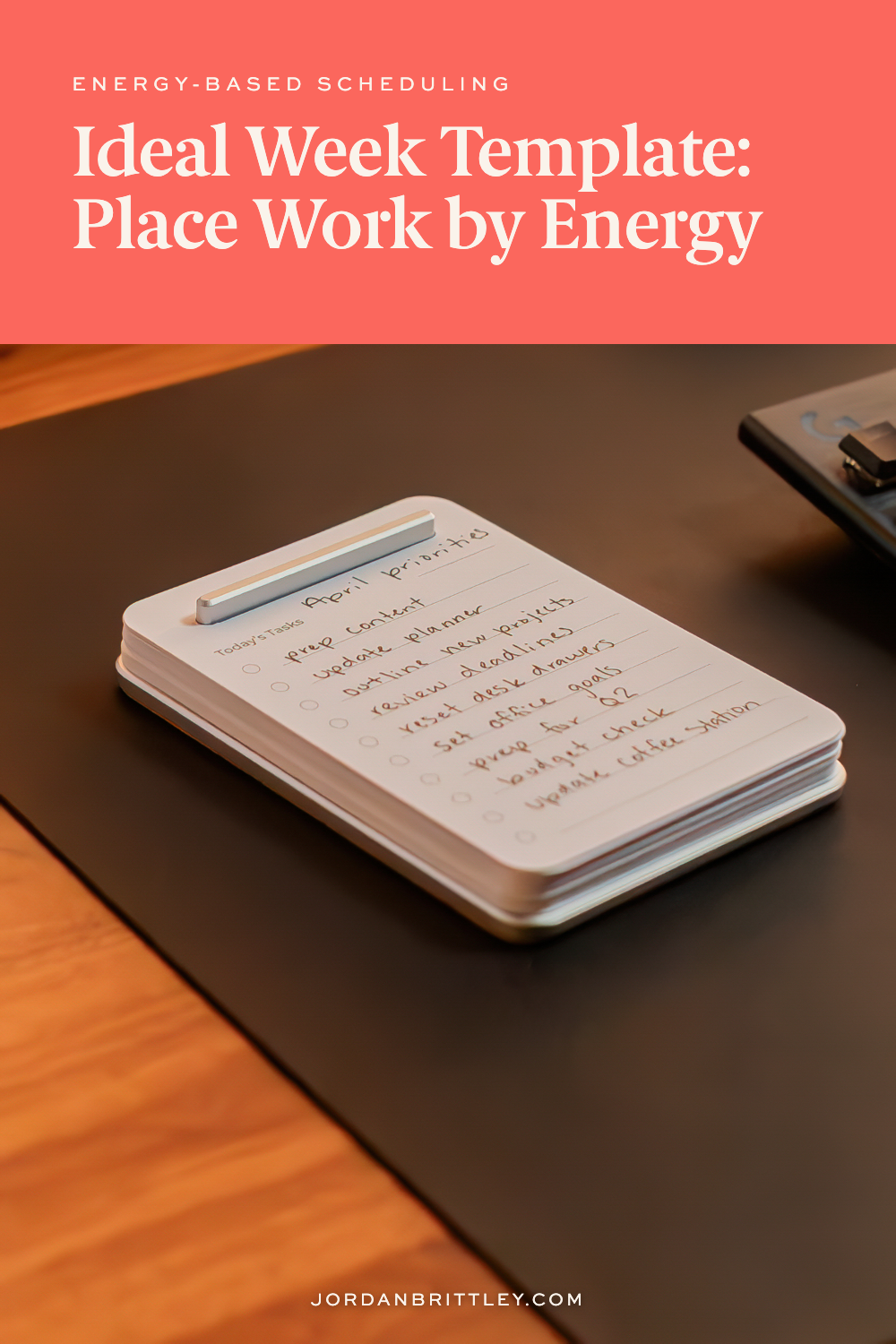
What changed was not a new app. It was a single page I filled out once: an ideal week template. Not a rigid hour-by-hour plan, just a picture of where each kind of work belongs on a normal week.
What an ideal week template actually is
An ideal week template is a blank weekly grid where you assign each day or block to a type of work instead of a specific task. Mornings might be for deep, creative work. One day might be for shoots, another for editing, another for the business side that never feels urgent until it is.
It is a template, so you reuse it. You are not deciding when to do your bookkeeping every single week. You decided once, and now the week has a shape you can lean on.
Why a shape beats a to-do list
Part of why a shape works is that it stops you re-deciding the same things every morning. The American Psychological Association on learning and memory describes how repetition turns effortful choices into automatic ones, which is the whole benefit of a week that looks roughly the same each time.
A to-do list tells you what. It says nothing about when, and that is usually where the week falls apart. Twenty things on a list all feel like they belong to right now.
A weekly shape answers the when before the week starts. When a new task shows up, you are not asking "when will I ever do this." You are asking "which block does this belong in," which is a question you can actually answer. This is the same reason time blocking changed how I run my business, scaled up from one day to the whole week.
How to build yours
Start with your fixed points. Drop in the things that do not move: client calls, school pickup, the standing meeting. Those are your anchors.
Then place your work by energy, not just by category. Put the work that needs your sharpest thinking where your energy is highest. For me that is morning. Save the lighter, repetitive work for the afternoon dip, when answering email feels about right and writing a proposal does not.
Group like with like. A day that bounces between a shoot, a sales call, and three hours of editing costs you more than the clock shows, because every switch has a tax. Batch the similar work together and the day gets noticeably easier. My weekly planning ritual is just me checking the real week against this template every Sunday.
What to do when the week breaks
Expect it to break, and do not read the break as proof the template failed. The American Psychological Association on stress describes how pressure narrows attention, so the weeks you most need the shape are exactly the weeks you are least able to invent one. Falling back to a written template is the point of having one.
It will break. A kid gets sick, a shoot reschedules, a launch eats a Tuesday. The template is not a promise that every week goes to plan. It is the thing you come back to when it does not.
When a day blows up, you do not rebuild your whole life. You look at the template and ask which block this work was supposed to live in, then find the next open version of that block. The structure holds even when a single week does not.
Make one this week
Open a blank weekly grid. Add your anchors, place your deep work where your energy is highest, and batch the rest. Give it two weeks before you judge it. The first version will be wrong in small ways, and that is fine, because now you have something to adjust instead of a blank page to dread.
A good week is rarely an accident. It is usually a shape you decided on ahead of time and then kept showing up for.
Don't stop starting.
If content keeps being the block that slides, the fix is usually supply rather than scheduling. Brand photo and video sessions give you a library to post from, so that block gets shorter instead of skipped.
You Might Also Like
Plan the week with time blocking
Manage energy instead of hours